
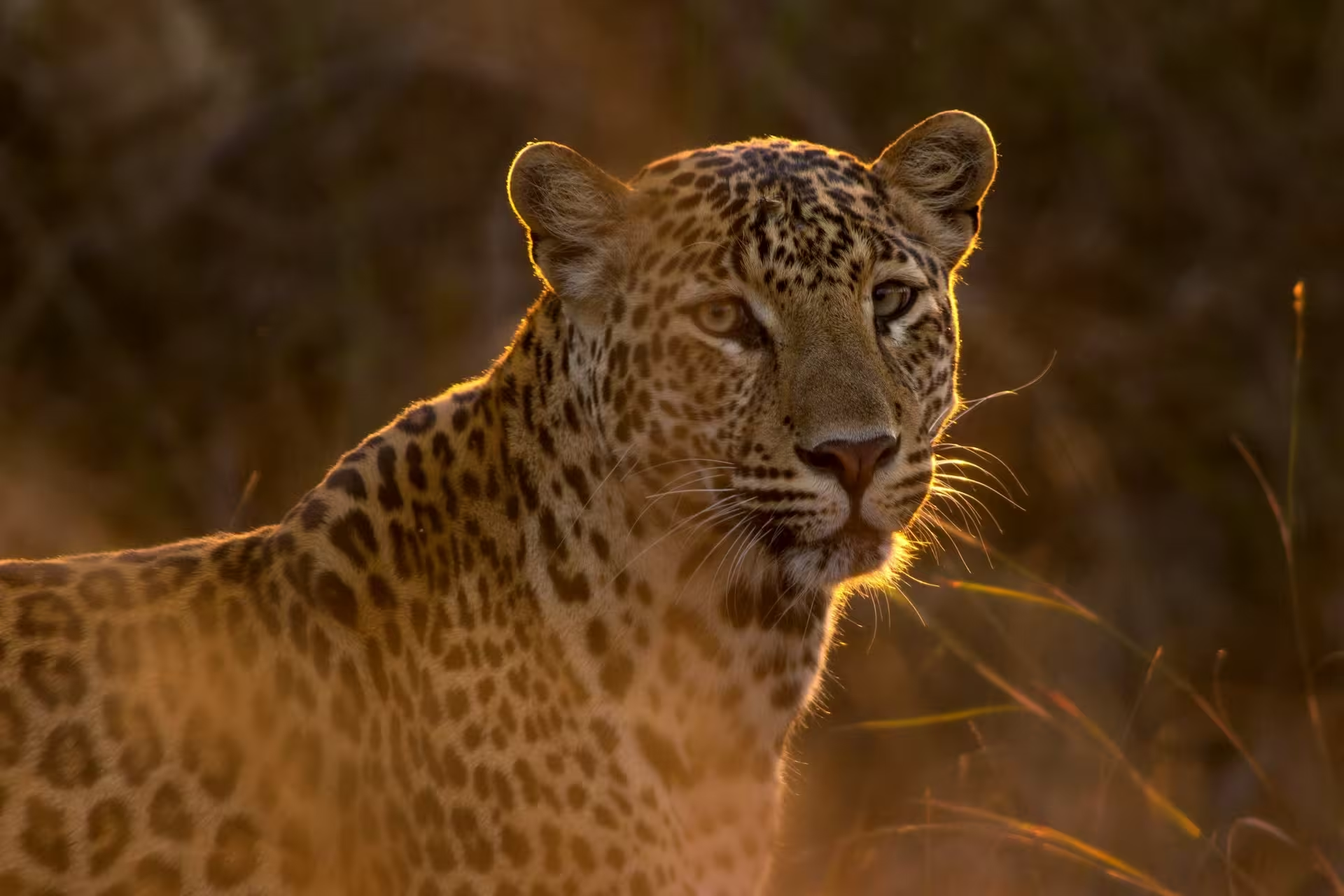
India is home to some of the world's most remarkable wild cats. Tigers often receive the most attention, but leopards are equally fascinating because of their adaptability and wide distribution.
India has the Indian leopard across much of the country and the snow leopard in the high Himalayas. The northeast also supports the clouded leopard, a different wild cat that gets its name from its distinctive markings.
These cats occupy very different landscapes. Indian leopards live in forests, grasslands, hills and scrublands. Snow leopards survive in cold mountain environments, while clouded leopards prefer dense forests.
This guide explains the leopard species and leopard-named wild cats found in India, their habitats, distribution, behaviour and key differences.
How Many Leopard Species Are Found in India?
India is home to two species in the genus Panthera that are commonly called leopards:
- Indian leopard (Panthera pardus fusca)
- Snow leopard (Panthera uncia)
India is also home to the clouded leopard (Neofelis nebulosa). Despite its name, the clouded leopard is not a true leopard. It belongs to the separate genus Neofelis.
| Cat | Scientific Name | Genus | Distribution in India | Main Habitat |
| Indian leopard | Panthera pardus fusca | Panthera | Much of India | Forests, hills, grasslands and scrub |
| Snow leopard | Panthera uncia | Panthera | Himalayan region | High-altitude mountains |
| Clouded leopard | Neofelis nebulosa | Neofelis | Northeast India | Dense forests |
The Indian leopard is the most widespread of the three. It is also the leopard most likely to be encountered during a conventional wildlife safari.
Snow leopard sightings require specialised mountain trips. Clouded leopard sightings are even more difficult because the species lives in dense forests and is highly secretive.
Indian Leopard
The Indian leopard (Panthera pardus fusca) is one of India's most adaptable large predators.
It is generally recognised as a subspecies of the leopard and belongs to the genus Panthera. Tigers, lions and jaguars are also members of this genus.
Indian leopards can survive in a wide range of landscapes. They occur inside protected forests but can also use scrublands, rocky terrain and areas surrounding human settlements.
Their adaptability is one of the main reasons they have maintained such a broad distribution.
Where Is the Indian Leopard Found?
Indian leopards occur across large parts of the country.
Their distribution includes:
- Central India
- Western India
- Northern India
- Himalayan foothills
- Western Ghats
- Eastern India
- Parts of northeastern India
Important leopard landscapes overlap with several tiger habitats.
Pench, Kanha, Bandhavgarh, Tadoba, Satpura and Ranthambore are among the well-known wildlife destinations where visitors may encounter Indian leopards.
Indian Leopard Habitat
Indian leopards are not restricted to one particular habitat.
They can live in:
- Dry deciduous forests
- Tropical forests
- Scrublands
- Grasslands
- Rocky hills
- Forest edges
- Agricultural landscapes
- Areas near villages
They need suitable cover, water and sufficient prey rather than one specific vegetation type.
Rocky outcrops, dense vegetation and ravines can provide useful cover. Leopards also use trees for resting and may carry prey into branches.
What Does the Indian Leopard Eat?
The Indian leopard is an opportunistic predator.
Its diet varies according to the habitat and available prey. Common prey can include:
- Chital
- Sambar
- Wild boar
- Langurs
- Monkeys
- Peafowl
- Rodents
- Other small mammals
- Reptiles
- Livestock in some areas
This flexible diet helps leopards survive across very different landscapes.
Indian Leopard Behaviour
Indian leopards are generally solitary animals.
Adults usually maintain individual territories, although territory size varies according to habitat, prey availability and population density.
They are often active during the night, early morning and evening. However, daytime activity is also possible.
Leopards are excellent climbers. They may rest in trees and can sometimes carry prey into branches.
This behaviour can help protect a kill from scavengers and competing predators.
Indian Leopard Adaptations
Several adaptations make the Indian leopard an effective predator.
Its spotted coat provides camouflage among vegetation and broken shadows. Strong forelimbs help it overpower prey, while powerful jaws allow it to kill and carry food.
Its climbing ability is particularly important.
Unlike many large predators, leopards can move easily through trees. This gives them access to resting places and helps them protect kills from other animals.
Most importantly, the Indian leopard can adapt its behaviour and diet to changing environments.
Snow Leopard
The snow leopard (Panthera uncia) is one of India's most elusive wild cats.
It lives in the high mountains of the Himalayas and has evolved to survive cold temperatures, steep slopes and rugged terrain.
Snow leopards are very different from Indian leopards in appearance, habitat and behaviour. Their thick fur, broad paws and long tail help them cope with extreme mountain conditions.
Where Is the Snow Leopard Found in India?
In India, snow leopards occur across parts of the Himalayan region.
Their range includes:
- Ladakh
- Jammu and Kashmir
- Himachal Pradesh
- Uttarakhand
- Sikkim
- Arunachal Pradesh
Ladakh and Himachal Pradesh are particularly well known for snow leopard tourism.
Snow Leopard Habitat
Snow leopards occupy rugged high-altitude landscapes.
Their habitat includes:
- Rocky slopes
- Alpine meadows
- Mountain valleys
- High-altitude plateaus
- Scree slopes
- Cold desert landscapes
Some of these landscapes appear almost barren to visitors. However, they support mountain prey that provides the snow leopard with food.
Snow Leopard Adaptations
The snow leopard has several adaptations for life in extreme cold.
Its thick fur provides insulation. Its broad paws help it move over snow, while its long tail provides balance on steep terrain.
The tail also helps conserve heat when the animal rests.
Its body is compact and muscular, allowing it to move efficiently through difficult mountain terrain.
These adaptations make the snow leopard one of the most specialised predators in India's high-altitude ecosystems.
What Does the Snow Leopard Eat?
Snow leopards primarily hunt mountain prey.
Their diet can include:
- Bharal or blue sheep
- Himalayan ibex
- Himalayan tahr
- Wild goats
- Marmots
- Pikas
- Small mammals
- Birds
The exact prey available varies between different Himalayan landscapes.
Why Are Snow Leopards Difficult to See?
Snow leopards are naturally elusive.
Their greyish coat blends with rocky terrain, and their mountain habitat covers large areas with limited road access.
They can also move across steep slopes and valleys that are difficult for people to reach.
For these reasons, finding a snow leopard requires patience, experienced trackers and specialised wildlife trips.
Clouded Leopard
The clouded leopard (Neofelis nebulosa) is one of India's most mysterious wild cats.
Despite its common name, it is not a true leopard.
The species belongs to the genus Neofelis. Its name comes from the large, cloud-like markings covering its coat.
Clouded leopards are particularly well adapted to forest environments and are excellent climbers.
Where Is the Clouded Leopard Found in India?
In India, clouded leopards are mainly associated with the northeast.
Their distribution includes parts of:
- Assam
- Arunachal Pradesh
- Meghalaya
- Nagaland
- Mizoram
- Tripura
- Sikkim
They depend heavily on forest habitats and are difficult to observe in the wild.
Clouded Leopard Habitat
Clouded leopards inhabit dense forest environments.
Their habitat can include:
- Tropical evergreen forests
- Subtropical forests
- Bamboo forests
- Forested hills
- Dense woodland
Their strong climbing ability allows them to use trees extensively.
The species has unusually flexible ankle joints, which help it climb down tree trunks headfirst.
What Does the Clouded Leopard Eat?
Clouded leopards have a varied diet.
Potential prey includes:
- Primates
- Small deer
- Wild pigs
- Birds
- Rodents
- Reptiles
- Other small and medium-sized mammals
Their ability to hunt both on the ground and in trees gives them access to a broad range of prey.
Indian Leopard vs Snow Leopard vs Clouded Leopard
Although all three have "leopard" in their common names, they are distinct wild cats.
| Feature | Indian Leopard | Snow Leopard | Clouded Leopard |
| Scientific name | Panthera pardus fusca | Panthera uncia | Neofelis nebulosa |
| Genus | Panthera | Panthera | Neofelis |
| Main habitat | Forests, grasslands and hills | High mountains | Dense forests |
| Indian distribution | Much of India | Himalayan region | Northeast India |
| Coat pattern | Rosettes | Spots and rosettes | Large cloud-like markings |
| Tail | Long | Very long and thick | Long |
| Climbing ability | Excellent | Good | Exceptional |
| Cold adaptation | Moderate | Very high | Limited |
| Typical lifestyle | Mostly solitary | Mostly solitary | Mostly solitary |
The Indian leopard and snow leopard belong to the same genus but are separate species.
The clouded leopard is more distantly related and belongs to another genus.
Where Are Leopards Found in India?
The Indian leopard has the widest distribution of these cats.
Central India provides extensive leopard habitat across several protected landscapes. The Western Ghats also support important leopard populations.
The Himalayan foothills provide another major habitat zone.
In contrast, snow leopard habitat is restricted to high-altitude Himalayan landscapes. Clouded leopards have a much narrower distribution in northeastern India.
This geographical diversity makes India an important country for studying different forms of wild-cat adaptation.
Leopard Conservation in India
Leopards face several conservation challenges across their range.
Important threats include:
- Habitat loss
- Habitat fragmentation
- Loss of natural prey
- Human-wildlife conflict
- Poaching
- Infrastructure development
- Road and railway expansion
- Livestock depredation
Indian leopards often live outside protected areas or move between protected forests and surrounding landscapes.
This makes landscape-level conservation important.
Wildlife corridors can help connect fragmented habitats. Community participation can also help reduce conflict between people and leopards.
Snow leopard conservation requires protecting high-altitude habitats and maintaining healthy wild prey populations.
Clouded leopard conservation depends heavily on protecting northeastern forests from habitat loss and fragmentation.
Leopards and India's Wildlife
Leopards represent India's remarkable ecological diversity.
The Indian leopard demonstrates how a large predator can adapt to many different environments. The snow leopard shows the extreme specialisation required to survive in high mountains. The clouded leopard represents the unique forest wildlife of northeastern India.
Together, these cats form an important part of India's rich wild-cat diversity.
For travellers interested in India's wider wildlife, they also provide an opportunity to look beyond the country's famous tigers.
Frequently Asked Questions About Leopards of India
How many leopard species are found in India?
India has the Indian leopard and snow leopard, both belonging to the genus Panthera. The clouded leopard is also found in India, mainly in the northeast, but belongs to the separate genus Neofelis. It is therefore not a true leopard.
Is the Indian leopard found throughout India?
No. Indian leopards have a broad distribution but are not found uniformly across every part of the country. They occur across many forest, grassland, hill and scrub landscapes where suitable habitat and prey are available.
Is the snow leopard the same as the Indian leopard?
No. The snow leopard is a separate species called Panthera uncia. It is adapted to high-altitude Himalayan environments, while the Indian leopard lives across a much broader range of habitats.
Is the clouded leopard a leopard?
The clouded leopard is not a true leopard. It belongs to the genus Neofelis, while the Indian leopard belongs to Panthera. It is named for its distinctive cloud-shaped coat markings.
Where are Indian leopards found?
Indian leopards occur across many parts of India, including central India, western India, northern India, the Himalayan foothills and the Western Ghats. Several tiger reserves also support leopard populations.
What is the biggest difference between an Indian leopard and a snow leopard?
The biggest difference is their habitat and adaptations. Indian leopards occupy diverse forests and landscapes, while snow leopards are specialised for cold, rugged and high-altitude mountain environments.
Conclusion
India is home to a remarkable diversity of leopard and leopard-named wild cats.
The Indian leopard is the country's most widespread leopard and one of its most adaptable predators. The snow leopard survives in the high Himalayas, while the clouded leopard inhabits the dense forests of northeastern India.
Their different habitats, physical adaptations and behaviours demonstrate the diversity of India's wildlife landscapes.
Understanding these differences also helps travellers choose the right destination when planning a wildlife experience in India.